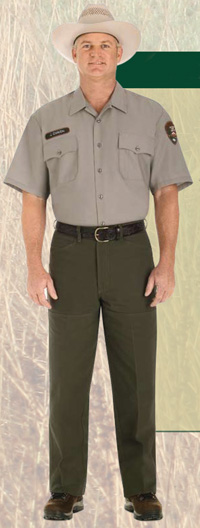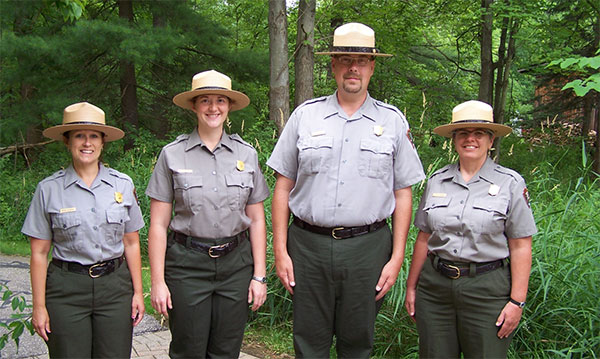
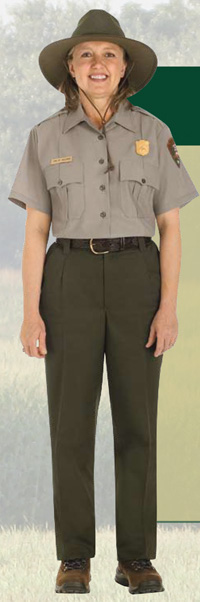
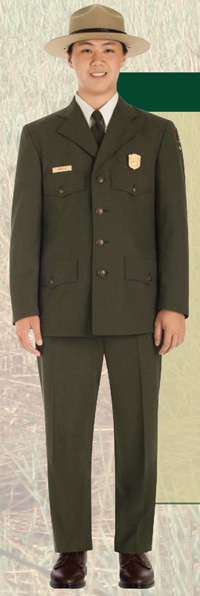
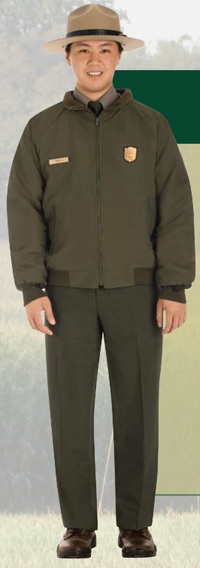
By Peter Hildebrandt The National Parks have long been crown jewels of the natural world and our nation’s history a legacy preserved nearly a century and a half ago. Perhaps because visitors may be easily overwhelmed by the expansive parks, having a distinctive, easily recognizable uniform has remained a top priority of the National Park Service since the 1920s. In the early decades of the park service’s operations, they went through a number of changes, additions and experimentations with their ranger uniforms. A number of key features such as the distinctive hat linger on. But now, after years of experience, the uniform is the very recognizable gray shirt, green trousers and distinctive hat for both women and men that we come to look for when we first pull into a national park, memorial or historic site.
R. Bryce Workman in 1996 compiled from many different records the story of the NPS employee uniform’s evolution. According to Workman, at first NPS uniforms had much in common with those of the U.S. Army. This makes sense, as Park Service employees actually replaced the soldiers handling such work in a number of the western parks. Early accessories were of a higher quality for non-ranger officers than for those in the field. But in 1928, the decision was made to make the quality the same for those outside doing much of the physical work of the parks as for administrators. This no doubt proved a wise decision as rangers have more than lived up to expectations, providing visitors with trusted and knowledgeable guidance while wearing their well-known uniforms. These rangers often ease the minds of curious and anxious park-goers many miles from home.
In the early ’50s, uniform regulations were developed for the use of the emblem as a patch on Park Service employees’ sleeves. Permanent employees received three patches and seasonal employees received one patch. Prior to 1936, belts were not covered in uniform policy regulations. Then over the next two-and-a-half decades, various changes in the style of the leather belt worn came about. In 1961 the belt became somewhat standardized with a buckle the full width of the 1-1/2 inches-wide leather belt and the initials “USNPS,” which had come to be embossed on the belt over the years, eliminated. Even something as basic as buttons had a long history starting with the first known button in 1907. From a photo of Sequoia National Park ranger, Karl Keller, taken in 1910, a pine tree with “Forest” above and “Service” below first appeared. The first official NPS uniforms were sanctioned in 1911, ordered from Parker, Bridget & Co. of Washington, D.C. Early buttons were produced by the Waterbury Button Company of Waterbury, Conn. At that time, despite the rangers having to furnish their own uniforms, buttons were issued to them for free.
Other elements of the NPS uniform over the years included hatbands and straps, law enforcement insignia, length-of-service insignia, nametags, tie ornaments and pins, and miscellaneous items. These included pins or patches for such things as charity fundraisers or the nation’s bicentennial celebration in 1976; such accessories were especially prevalent in the 1970s. The long and rather complicated history of these various components reflects the give-and-take between personalization of the uniforms by individual park service personnel and specified NPS administrative office guidelines clearing up any questions or misunderstandings. For instance, after World War II, NPS employees were permitted to wear various insignia on their uniforms from their time in the armed services. This was originally to be for 60 days. However, much interpretation of that rule and stretching of the verbal directions led to an actual written regulation in 1961 almost 20 years later ending the practice. Though Smokey Bear has been the Forest Service’s often ubiquitous symbol for decades, many people often equate it with the National Park Service. This is for good reason. Park rangers, both female and male, have been seen wearing the distinctive hats for as long as most people can remember. John B. Stetson’s “Boss of the Plains” was first marketed in 1863. Its association as a “ranger” hat may have come from its early use by the Texas Rangers. Its popularity grew to the point where Stetson became a generic term in much the same way Fedora did for city slickers. In the 1960s, women wore stewardess-style caps for a time. But despite all the changes over the years the Smokey Bear hat stuck. A straw version for summertime wear came about. A soft version for women proved too soft and floppy. Now both men and women wear the stiff felt or straw hat, keeping it clean through its three-plus-year lifespan. VF Imagewear Inc. has had the contract to supply the NPS uniforms since 1978, though the company had a different name R&R Uniforms back then, according to Ramie Lynch, National Park Service Uniform Program Manager. Every five years, the contract goes out to bid, and VF has consistently been able to beat out any others. Lynch has been involved with the uniform program since 1999 and has been program manager since 2002. Lynch himself worked as a Park Ranger at Natchez National Historic Park in Natchez, Miss., and on the National Mall in Washington, D.C. “I’ve worn the uniform in the field so I do understand what the issues are,” adds Lynch. “As part of the contract, VF Imagewear must go out on field visits to meet with our employees and just let them know what they’re doing with the program and to find out from them what their concerns are. And most of the time when the uniform company travels, I try to accompany them. I meet with employees and explain the program to them, but also get feedback. When I get back I normally try to address those issues and make the necessary changes. Overall the duties a ranger is engaged in will determine what type of uniform they will wear and what accessories are required. “Our goal as spelled out in our regulations is to maintain a neutral image encouraging approachability with the broadest spectrum of the visiting public.’ In other words, there really isn’t any room for individuality; that’s why it’s called a uniform. Body piercings and blue hair are not something acceptable for a ranger to be wearing. In the past, with all the pins, additions to the uniform and other paraphernalia, it was a similar situation; they finally had to let go of all that. They decided from now on everyone has to wear the same uniform.” Ironically, now Lynch is dealing with forces interested in going back to some of the older attempts at individuality. Until 1977, there was a separate women’s uniform. Women threatened to file a class action lawsuit to have the same uniform as the men. But now some women are articulating their desire to not look like the men. Within the uniform program, if an individual is a non-standard size, they’ll do a “made to measure,” Lynch says. This takes three to four months. But from that original order forward, when the individual orders anything, the uniform or accessories will come in that size needed at no extra cost even though this typically would cost up to three times the normal price.
If any film company requests use of the uniform on a character in a movie or television show, the standard gray shirt, green trousers and Smokey hat are allowed to be depicted. But such items as the trademarked hatband with the Sequoia cone pattern are not permitted to be used, nor is the belt. The famous arrowhead patch is also not to be used; this is what makes the uniform unique. “The uniform today is basically the same as that envisioned in 1920. Even though it now has shoes and trousers instead of boots and breeches, there are still far more similarities than differences. The cut of the dress coat has been altered somewhat to accommodate the women in the service, but the color remains the forest green laid down in the early years, and the buttons and collar ornaments have survived long enough to become a tradition,” says Workman. Old hands like Walter Fry or Dusty Lewis would still recognize a park ranger if they were to run into him today. The old saying “the more things change, the more they remain the same” is nowhere truer than in the National Park Service. Above story first appeared in MADE TO MEASURE Magazine, Spring & Summer 2010 issue. All rights reserved. Photos appear by special permission. |
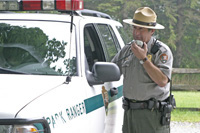 The earliest park service employees did not wear a specific uniform. It’s unclear whether or not they even wore badges. The first clear reference to badges for rangers relates to their use by Yellowstone National Park scouts. A badge the U.S. Department of the Interior had in 1898 apparently was the first one in use by so-called “forest rangers,” a term that was just coming into use at that time. Some ten years later something more identifiable an actual uniform was developed, bringing with it more awareness of the rangers and their work.
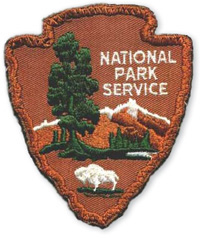
 Perhaps of equal importance of the uniform as symbol of what the parks stood for was the NPS emblem, which eventually came about in 1951. A contest held in 1949 yielded winner Dudley Bayliss $50 in prize money. But his design, one featuring a curving highway heading into distant mountains, wasn’t used. After some soul searching, the NPS decided the best route was an emblem more symbolic of what the parks were all about. Aubrey V. Neasham, historian for Region IV (precursor of what would become the Western Region) put forth the idea of an emblem containing such symbols as an arrowhead, buffalo or tree.
 After the pine tree, the eagle in somewhat of a profile view was used on the buttons. From 1903 an eagle in a pose greatly resembling that on the U.S. Presidential Seal was used. The eagle is still in use on current uniform buttons.
 What makes the contract especially tough is its complexity. It has a lot of different items in the program, not simply a shirt and pants. VF provides all components of the uniform including pins, insignias and patches. The program includes hat bands, outerwear, shoes, socks and more; it truly runs the gamut.